Showing posts with label Liberty. Show all posts

Wednesday, April 24, 2019

Liberty County Courthouse

South entrance - the original doors and transoms have been replaced 
Each of the Texas Courthouses have an interesting story or two to share and I'm always excited to visit, explore and research each one! The Liberty County Courthouse is remarkable in that it has had very little change to the exterior since its completion in 1931 and its interior remains remarkably intact today.  This courthouse is the seventh one to occupy the courthouse square laid out in 1831 and it was listed on the National Register of Historic Places in 2002. That's impressive, so come on, let's go exploring!
***
The discovery of oil in Texas created many boomtowns in southeast Texas and brought new prosperity to existing towns like Liberty at the beginning of the 20th century. In 1925 the Liberty County Commisioners, encouraged by the county's oil driven economic boom, requested Houston architect Corneil G. Curtis to prepare a comparison of repairing and updating the existing 1895 courthouse versus replacing it. His report thoroughly examined both scenarios, but he favored a new, modern courthouse of fireproof construction.

The progressive minded commissioners agreed and asked for the submission of bids. However, the bids were considered to be too high and no action was taken for three years; yes, government moves slowly. A second request for bids in September 1930 led to the awarding of the construction contract to M.H. Ryland of Uvalde in November.  The new courthouse would be completed in December 1931 at an approximate cost of $250,000.


There had been considerable opposition to the demolition of the existing courthouse, but the "demands of progress" overcame the protests. The 1895 courthouse was vacated, demolished and replaced with a new, modern building demonstrating the County's progressive attitude of moving forward into the modern world.

Curtis' design incorporated the era's most current and progressive architectural trends and is now considered one of the earliest examples of Art Deco architecture in Texas. Interestingly it is also referred to as a "modernistic" (or Modern Classical) example of Art Deco in that the interior is relatively unchanged from the courthouse designs of the late 19th century while the exterior reflects the modern influence.


The two story courthouse is constructed of concrete and steel and finished with Texas Cordova Cream limestone. A low earth berm surrounds the windows of the raised basement to give visual height to the flatness of the site. A two story addition, built in 1956, covers most of the west side of the courthouse including the original west entrance, but overall does not detract from the original courthouse design.
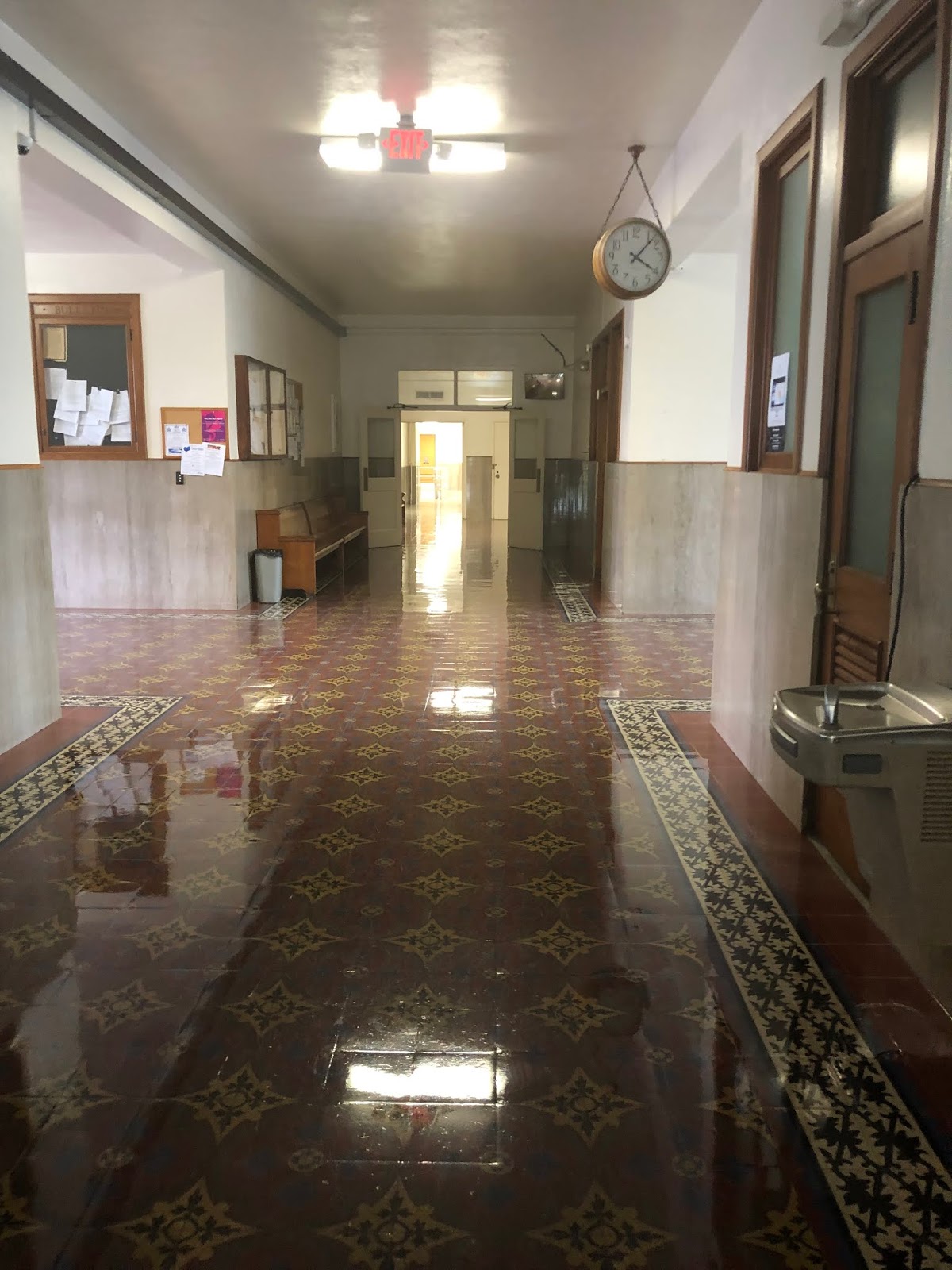
Central first-floor corridor, looking west
The interior is a traditional four entrance plan with corridors that divide each floor into four quadrants. Stairways at each end of the east-west corridor provide access to the upper and lower floors. The original exterior doors and transoms have been replaced, but the building retains most of its original integrity including beautiful mosaic floor tiles and marble wainscotting.
Original mosaic tile flooring
Marble wainscoting and original steam heat radiator in east stairwell
District Courtroom
The double-height District Courtroom retains all of its original furnishings, finishes, and light fixtures.  The courtroom's walls mimic the exterior with flat pilasters and and an "egg-and-dart" band at the top.  This room is considered to be an excellent example of Art Deco design.
District Courtroom light fixture - bronze with faceted glass
While the exterior follows the Art Deco concept of geometric massing, flat unornamented surfaces and stylized forms of ornamentation it also picks up on the Texas theme with low-relief sculptured panels featuring longhorns, covered wagons, water lilies pine trees, oil derricks and the Texas Lone Star.  Some of these can be seen in the photo below.
Lone Stars, covered wagons and longhorns are etched on pilaster tops.
Eagle over the door represents the building's Federal government function.
Liberty bells are embossed between first and second floor windows.

Northeast corner
The waves along the dado represent the nearby Gulf of Mexico. 
The thin strips of stone set between the larger blocks of limestone give visual appeal.
North entrance

Thursday, March 28, 2019

The Ott Hotel


Old buildings may seem boring and useless to some people, but those of us that love them know that while many buildings can be very interesting in their design and history others are just downright fun.  Take for instance, the Ott Hotel in Liberty, Texas. Built in 1928 to attract travelers on the nearby Texas & New Orleans railroad and the Old Spanish Trail highway the hotel still serves travelers (and the curious) today.  It is also home to several spirits that have garnered much attention over the years!
In the early 1900's the railroad line cutting through Liberty boosted the community into a center for trade, timber and agriculture.  The discovery of oil in nearby fields further prompted construction of buildings for restaurants, stores and hotels, including the Ott Hotel built by John and Sallie Ott. The hotel's location adjacent to the railroad tracks and close to the Liberty depot made it popular with rail passengers. Automobile tourists found it a convenient place to spend the night as well as those with business to conduct at the nearby Liberty County Courthouse.
The Ott family owned the hotel until 2002 when it was sold to Kelly and Susan McCain who restored the hotel to its original 1928 appearance. Although, truthfully, from what I saw I can't be certain it is authentic; however, it is fun and delightfully quirky. Today it is still in use as as a hotel and residence and their Facebook page indicated there are weddings held here from time to time. The hotel doesn't have a website and there is very little other information available except for numerous reports of its supernatural activities.  In 2005 the Ott Hotel was designated a Texas Historic Landmark.
First floor hallway

Hotel lobby
Many famous people have stayed here including John Wayne, Dale and Roy Evans, and Dan Rather. At least 20 people are said to have died in the hotel with some of their spirits still residing here.  The property is a certified "haunted property" having had over 50 paranormal investigations conducted. The day I visited I didn't feel a chill or anything creepy, perhaps the spirits just didn't want to deal with me! 

The hotel lobby features an original front desk and other antique memorabilia.  Pictures of Liberty through the years line the first floor hallway. From time to time the hotel offers tours and I'm hoping to catch one, but for now it was a fun find!