Showing posts with label Texas. Show all posts

Tuesday, August 31, 2021

The Onion Creek Post Office


The Post Office's front door

In July 2020 I shared a brief history of the Onion Creek Stagecoach Park in Buda, TX.  I recently returned to Buda and stopped by the park to explore this small, limestone block building behind the stagecoach stop house.  From reading the National Register of Historic Places nomination form I knew that it had served for a few years as the Onion Creek post office.  Truthfully, there isn't much to see, but there is some history here worth mentioning as the post office and the stage stop worked together to serve the community and connect it with other communities in Texas and beyond.

Carved lentin above the post office door, possibly commemorating the celebration of the Nation's centennial

The Austin to San Antonio stagecoach route found the Onion Creek area ideal for a stopping place to water horses or to change them out if needed.  The route was considered to be a "Fast Line" in that it only took 13 hours to travel from Austin to San Antonio. Modern travelers often feel is still takes that long due to congested traffic!

Hays County, Austin to the North with San Antonio to the South

Quite possibly travelers along this route would have taken the stage operated by the team of Sawyer & Risher.  The 4-horse stage left San Antonio every other day at 6 A.M. with stops in Selma, New Braunfels, San Marcos, and so on until reaching Austin.  From Austin you could connect with the rest of Texas and beyond.  (source:  Texas Transportation Archive).

The Onion Creek post office and stage stop were established in April 1875.  Here, the mail would be delivered and picked up and the team would be watered with fresh water from nearby Onion Creek.  If need be, horses could be changed out at the stop.  Travelers rarely spent a night at this stop, it was the equivalent of a modern-day rest stop along the interstate.

Originally there was a small rectangular window under this carving on the side of the building.

The post office was a one-room limestone brick structure, constructed between 1875 and 1876.  Facing the door of the structure was a two-room dog trot cabin that was home to the postmaster.  The post ofice would only serve this area for a few years until the post-Civil War boom brought growth to the area as well as the International & Great Northern railroad;  the stagecoach line was discontinued. The town of Buda (pronounced Bew-dah) was officially established and the post office relocated a short distance into town.

View of the back of the post office. 

On the left side of the building are the remains of a cistern and concrete water trough.  The piece of equipment behind the building is the remant of a pump house that was attached after the stage stop closed. The little building was in a very delapidated state when restoration began.  Happily, the post office building has withstood the test of time due to its outstanding craftmanship, considered very unusual for the time period of its construction.

Before restoration. Photo c. 2002, retrieved from NRHP nomination form 8.31.21


Saturday, July 3, 2021

From the library to the museum


30 October 2020

On December 7, 1975, the Bell County Museum hosted its official opening and this building at 201 N. Main Street in Belton, Texas, began a new phase of life, welcoming visitors inside to explore the County's history. Citizens were already very familiar with it as it had been serving the community since 1905 as Belton's Carnegie Library.  A new library had been built nearby, so the Bell County Commissioners granted use of the building to the Bell County Historical Commission. 


The library traces its beginning to 1899, when the Women's Wednesday Club met for the first time in the parlor of a local hotel with the purpose of establishing a public library in the city of Belton. Each member donated a book, collecting 350 volumes to form the new library which opened its first location in a small room in the hotel. By the time the new Carnegie Library opened in 1905 the Club had collected over 1,500 books. 

No other building in Belton exhibits the rich details of the library building.

The Club began to seek funding from the Carnegie Foundation for a library building, sending letters in 1899, 1902, and 1903 asking for funds for a public library to be constructed in Belton.  

After the 1903 request, the group was notified that if the City of Belton agreed by resolution of council to maintain a free public library at a cost of not less than a thousand dollars a year, and provide a suitable site, then Mr. Carnegie would be pleased to furnish $10,000 to help erect a free library for the city.  By proper resolution and public subscription, citizens were able to provide the lot and Mr. Carnegie forwarded his personal check.  (National Register of Historic Places nomination form)


Inside the first floor main room.  The display in the back contains one of Miriam "Ma" Ferguson's inaugural ball dresses and other artifacts from her life.  She was a Bell County native who served two terms as Texas' governor (that's a long story for another day). She was not a fashionista as this display shows the viewer!

The Carnegie Library building is considered to be significant in both its architecture and its indication of the cultural and educational awareness of Belton citizens. Other buildings in Belton constructed in this time period were designed with classical elements, but the library's Beaux-Arts classicism is considered to be "exuberant" in its design and ornamentation.  


The little known firm of Smith and Moore designed the library.  The contractor, Ben Lee, was well know to Belton for the local buildings he had constructed, one of which was the Bell County Courthouse.


The two-story library consisted of an open first-floor room separated into four spaces by Ionic columns supporting an entablature adorned with very detailed garland swags.  Each time I visit I am torn between gazing at the room's features and looking at the exhibits, it is mesmerizing!

Second floor auditorium/lecture hall stage

The second floor was devoted to a large auditorium type room used for lectures and meetings.  During the lean years of the Great Depression this room filled the need for a public meeting facility in Belton,  hosting graduation ceremonies, plays, and USO shows among others. This room is still used for public meetings and other gatherings. The day I wandered in to make photographs they were either setting up or taking down an exhibit, so the pictures are a little cluttered.

Second floor meeting room.  Both floors of the building feature pressed-tin ceilings

The preservation minded city of Belton began a comprehensive renovation program in 1988 that restored the interior to its 1905 floor plan by the removal of walls that had partitioned the rooms into smaller spaces. In 2003 the Museum began the 3-year process of connecting the library and the next-door Guffy Building with a two-story central walkway.  Today the main entrance into the library is through this walkway and the two buildings flow together seamlessly.

Original front entrance

Of the 32 libraries built in Texas with funding from the Carnegie Foundation 13 exist today. The Belton library retains most of its original features due to the fact that very little modifications took place over the years it served as a library.  The renovation and careful addition of the connecting walkway have served to preserve the library's original integrity.

Photograph taken in 1985, copied from the NRHP Belton Commercial Historic District nomination form.

The property was listed on the National Register of Historic places on March 4, 1985.


.


Tuesday, July 28, 2020

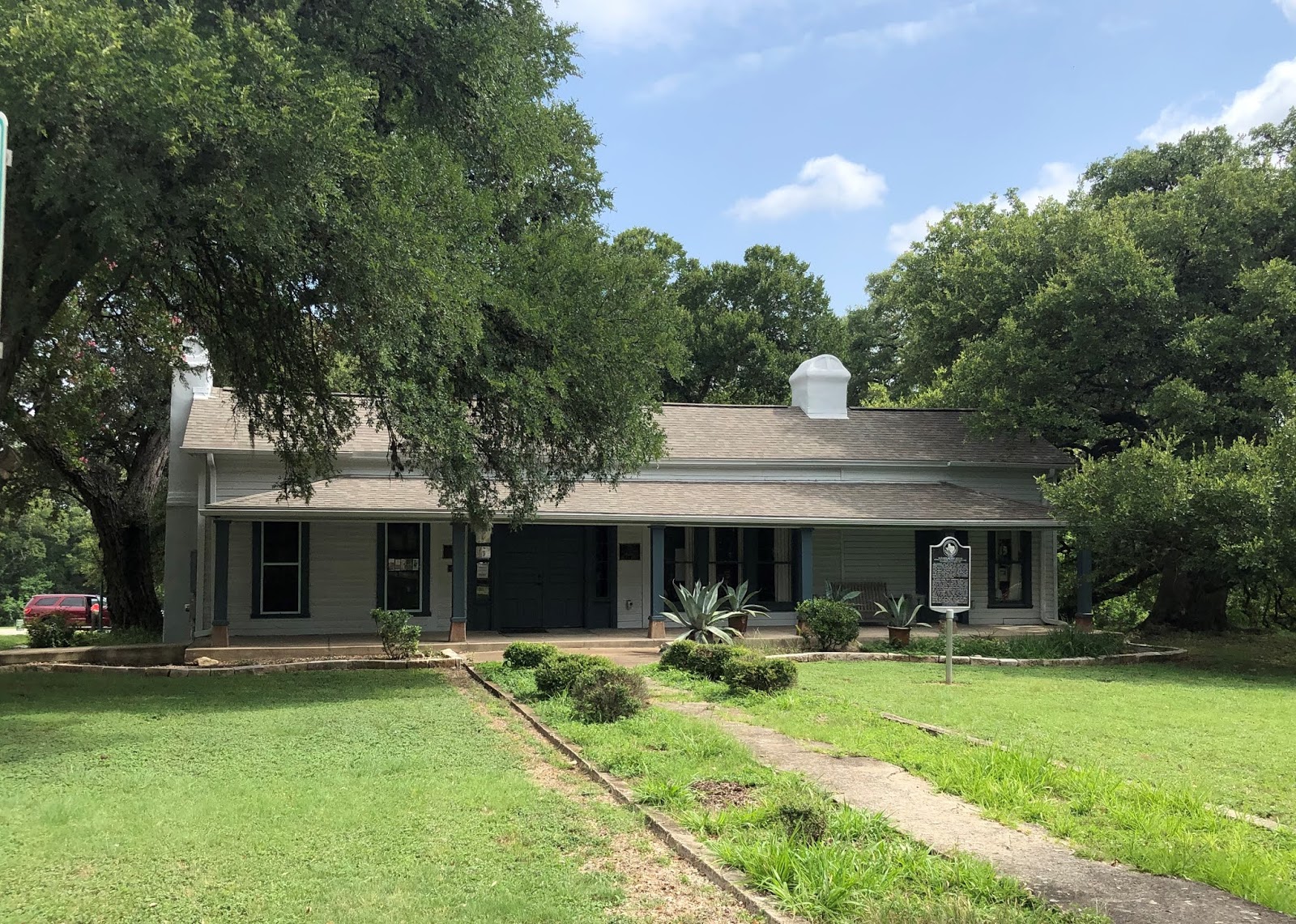
Onion Creek Post Office and Stagecoach House

The high bluff overlooking nearby Onion Creek made it a convenient location for a post office and stagecoach stop along what is now known as the Old San Antonio Road running from Austin to San Antonio, Texas. Water from the creek provided refreshment for the stagecoach horses and the sight was conveniently located near the highway. Ground was broken for the small, limestone post office in 1875 along with a two room dog-trot style house.

The post office was finished in 1876 and served residents of the community and stagecoach passengers until 1880 when the Postmaster moved the post office to the nearby developing town of Du Pre, renamed Buda (pronounced BYOO-dah). in the late 1880's. The completion of the International & Great Northern Railroad lines to San Antonio and Laredo ended the necessity of a stagecoach stop.

These very large oak trees to the side of the house probably saw the stagecoaches arrivals and departures.

T.E. McElroy and his wife bought the house and surrounding 234 acres and developed a successful livestock and agricultural program while eventually adding over 1,000 acres to the ranch. In 1906 Ann and John Severn purchased the ranch from the McElroy estate and continued the ranching operations.  Upon their deaths the house and property saw several owners and the eventual sale of individual tracts of land.  In 1998 the current owners, brothers Victor and Joe Stanzel, donated the house, post office building, and remaining 51-acres to the City of Buda with the stipulation that the house be restored and used for community purposes.

Renovation on the house revealed answers to questions about its transformation from the 1875 two room dog-trot style cabin to its current appearance.  Updates are traced to 1885, 1900, 1920, and 1950.  The Severns were very influential citizens and are thought to be responsible for the 1920 renovation; the house has been restored to that time period with the exception of a mantle painted by artists that rented the house for a time in the 1970's.

Evidence found during the renovation process indicates that the house was originally oriented to face the tributary of the creek located to what is now the rear of the house. The two rooms on either side of the front door comprised the original two room dog-trot cabin.

Each renovation seemed to change the structure even more while making it useful and modern for the residents.  As a result, it assumed some strange characteristics that added interest to the house.


I stumbled upon this property on a recent visit to Buda and had no idea of its historical significance until I returned home and began researching it.  I did not make many pictures, so a return trip when the weather cools off is on my go-to list. The surrounding park features many amenities as well as walking trails through the former stagecoach stop and ranching property.

The house serves at the Buda Visitor Center, but is currently closed due to the COVID pandemic.  However, from reading the nomination form for the National Register of Historic Places designation about the evolution of the cabin to modern home I am sure it will be worth exploring.

The remains of a watering trough are located a short distance from the house.
This one room building tweaked my imagination as to its original purpose.  There is a vent pipe visible on the back of the roof indicating that there was some type of wood burning stove inside.  Possibly the ranch office, but I'll have to find out on the next visit.

Monday, April 6, 2020

Bandera County, Texas Courthouse


The National Register of Historic Places nomination form for the Bandera County, Texas Courthouse begins with the statement

The three-Story rusticated cut limestone courthouse built in 1890-91 with a central clock tower, is the focal point of the Bandera public square, and the dominating architectural feature of the town

And, indeed it is dominating.  From anywhere in this charming Hill Country town that calls itself "The Cowboy Capital of the World" the Courthouse's clock tower can be seen. However, don't look up to see what time it is as the clock face is actually painted on the tower.  Time in Bandera is frozen at 10:10.

Bandera County was created in 1856 and the town of Bandera was designated as the county seat.  From 1877-1891 the county used a coursed rubble limestone building built in 1856 as its makeshift courthouse.  The completion of the current day courthouse in 1891 was a sign of Bandera's post-Civil War prosperity.


B.F. Trester, Jr. of San Antonio, Texas was chosen as the architect. In recent years an intriguing mystery about Trester and the design of the courthouse came to light in the discovery that an identical architectual twin existed in Boone County, KY.  Today, the Boone County Courthouse is altered in appearance, but it's still easy to see the similarities.  To read about this mystery and see comparison pictures click here.

On Friday, July 11, 1890 County Commissioners accepted the bid of William Braden and Sons to construct the Courthouse according to Trester's plans for a sum of $19,914.00. Sometime between that time and February, 1890, Trester passed away at the age of 40 years and County Commissioners appointed A.B. Frankel as supervising architect. 

Trester's death was just one of the delays that would plague Braden in completing the project.  These trials, including the walking off the job by Braden are detailed in The Bandera County Historian, Fall 1991 issue that commemorated the 100th anniversary of the Courthouse's completion. 


This article describes how Braden used itinerant Russian rock masons to cut the limestone blocks from a quarry across the Medina River. Sand for the mortar was dug from along Indian Creek and hauled to the construction site by two local men. The blocks were lifted in place "in four-man slings up staircase-like scaffolds"; as a result there were no lifting holes drilled into the stone blocks.


During 1966-67 the interior underwent a remodeling, although I couldn't tell what might have been remodeled as it seemed to retain many of its original features.  I did notice the wall-to-wall carpet in most areas of the building.  At the same time a one-story addition to the east side of the building altered its façade.  The windows were replace with modern aluminum frames.


Hallway of 1966-67 addition
I966-67 addition in foreground
In 1998 work to stabilize and repair the clock tower/cupola was undertaken after receiving an emergency grant from the Texas Historic Courthouse Preservation program.  Temporary shoring was used to stabilize the ceiling above the judges' bench in the district courtroom.  The tower and cupola were reinforced and the metal roof replaced.  Work was completed in 2006.  Just to note I could not find any reference as to when and why the tower had been painted silver. To see before and after pictures click here.

District Courtroom, August 2018
A very kind bailiff or deputy sheriff took me into the courtroom and into several offices to see the original fireplaces. 


 The Courthouse was designated as a Texas Historic Landmark in 1972 and listed in the National Register of Historic Places in 1979. 

Wednesday, March 6, 2019

The Alamo 2019

On this day in 1836 a pre-dawn attack by Santa Anna's forces breached the walls of the old mission compound and the defenders inside were all killed.  Four days earlier on March 2, 1836, Texas had declared its independence from Mexico while what has come to be known as the Battle of the Alamo had been raging since February 23rd. 
Approximately 200 men lost their lives when the Alamo was captured; their remains are now interred at nearby San Fernando Cathedral. 
A few weeks later the Texan forces under the leadership of Sam Houston would surprise Santa Anna and with the rallying battle cry of "Remember the Alamo" claim victory after an 18 minute battle. The Mexican forces would surrender on May 14th, but would maintain their stance that Texas was not independent and skirmishes would result from time to time. Texas would join the Union in 1845.

To read a chronology of the history of the Alamo click here to visit the Alamo's website.

Just to note I've kept this post short to focus on the commemoration of the fall of the Alamo, but am now planning to do some more posts relating to the Alamo. It has played a vital part in San Antonio's history and while often regarded as a "tourist must visit" site deserves recognition of its entire history. A previous post discussed the history of The DRT Meeting Hall (Alamo Hall) located on the Alamo grounds.


Saturday, August 11, 2018

Caldwell County Courthouse, Lockhart Texas

The Caldwell County Courthouse clock tower stands high above the surrounding buildings signalling to approaching visitors that they are near the Historic District. The ornate tower is the first hint of the eyecatching details of this 1894 Courthouse designed by Henry E.M. Guidon who eventually became a partner of San Antonio architect Alfred Giles. Contractor was Martin, Brynes and Johnston with an approximate cost of just over $54,000. The plans would be used again for the construction of the Goliad County Courthouse.

The clock tower houses the original 4-sided Seth Thomas clock and 900 pound bell. The clock has been restored after being removed from the tower in 1994 due to poor maintenance and theft of parts.  It rested on the dirt floor basement of the County Clerk's building until it was removed in 2008 and restored.  It's chime is beautiful!

Designed in the poplar Second Empire style with the Mansard roof and imposing clock tower, the Courthouse has towers that flank the north and south entrances and porticos on the east and west entrances.  The porticos were added after the contract was awarded at an additional cost of $600. The walls are sandstone blocks and the trim is "red muldoon stone" as specified in the construction contract.
Towers flanking the entrance
Portico
Entry portico
The building was built with electricity; water lines would be added later. A remodeling sometime prior to 1978 reconfigured much of the interior and covered original features with drop ceilings and plastic panelling; however, a $1.6 million renovation project between 1991 and 2000 restored the Courthouse interior to much of its original appearance and added HVAC, data/telecommunication capabilities and updated fire alarm and sprinkler systems. 


Second floor courtroom that was converted into offices during the 1970's

Second floor courtroom, beautifully restored

Second floor courtroom - I believe these benches were from the original courtroom, note the tile floor that is throughout the Courthouse. Balcony is accessible from the third floor.
The Courthouse was recorded as a Texas Historic Landmark in 1976. The Caldwell County Courthouse Historic District, which includes the Courthouse and 84 surrounding buildings on 25 acres of land, was added to the National Register of Historic Places in 1978.  

Monday, July 30, 2018

Gaslight-Baker Theater, Lockhart Texas


My first trip to Lockhart was with the intent of exploring the Caldwell County Courthouse. I had parked on the square and was crossing the street to the Courthouse and glanced to my right for oncoming traffic when I saw this building; I knew immediately that it had been a movie theater at one time and immediately left the square to explore!  

Located on a side street off the square, the Gaslight-Baker Theater has been providing citizens with  entertainment since its opening night on October 29, 1920. According to the theater's website there were two showings of "Old Kentucky" starring Anita Stewart and an estimated crowd of 1,500-2,000 people attended. 

At the time of its 1920 opening the theater was proclaimed by many to be more opulent and modern than many others in the state. Sadly, the theater underwent a remodeling in the 1930's and then another more extensive remodeling in the 1950's that give the theater much of its present day appearance. The pinkish ceramic tile was added to the lower exterior, as well as the angled front wall and enlarged marquee. The enclosure of the lobby probably dates to this remodeling.  The Gaslight-Baker also owns the building next door (barely visible to the right of the theater in the first picture) where there offices and box office are now located.
Mr. A.D. (Colonel) Baker had built this theater after his first theater burned; he would continue to own and operate it until his death in 1936. The Baker Show Company owned and operated the facility until 1959 when it was purchased by the Valentine family. The theater remained in operation until March 1984 and sat vacant until 1997 when the Lockhart Community Theater acquired the building and converted it to accomodate live theater productions. Their first production,"Steel Magnolias", opened in October 1998.  Ten years later LCT Baker Theater merged with Lockhart's Gaslight Theater to form today's Gaslight-Baker Theater and continues to offer year-round productions. The theater is part of the Caldwell Courthouse Historic District listed on the National Register of Historic Places in 1978.
Close up of  Proscenium Arch visible above stage set
A plaque on the theater exterior indicates that 
The original vaudeville stage, portions of the 1920s interior, 1935 Grande Drape and Proscenium Arch remain intact.
When the two theater groups merged the exterior of the building was refurbished, the lobby updated, and the balcony eventually was re-opened as a seating area. Interestingly, Mrs. Valentine had taken out all the seats and put in shag rugs for theater goers to sit on sometime in the 1970's.

I returned to Lockhart recently to see the current production, The Lion in Winter, which did not disappoint.  The staging and acting was outstanding and the theater warm and welcoming.