Two months after I started writing this blog in 2013 I posted about the Texas & Pacific Railroad Hospital I had discovered on a visit to Marshall, Texas the previous summer in July, 2012. Over the years I've received comment notifications from time to time, but did not ealize until today it is the most viewed blog post I've ever written with 2,435 views. Click on the link above to read that post.
While I'm surprised I'm also pleased that so many people have read this post about a building that has been left to decay. From the comments I'm sure it is a place filled with many memories for the people of the Marshall area who were so closely connected to the railroad.
I tried to pull up more current information and found pictures, but no news items or related stories. There were several pictures with comments that those who ventured into the building experienced paranormal type experiences and heard mysterious noises! Now I'm anxious to go back to Marshall and try to find some local sources that will tell me more about this intriguing building.
Behind the door of every old building there's a story waiting to be revealed...
Monday, May 6, 2019
Wednesday, April 24, 2019
Liberty County Courthouse
![]() |
| South entrance - the original doors and transoms have been replaced |
***
The discovery of oil in Texas created many boomtowns in southeast Texas and brought new prosperity to existing towns like Liberty at the beginning of the 20th century. In 1925 the Liberty County Commisioners, encouraged by the county's oil driven economic boom, requested Houston architect Corneil G. Curtis to prepare a comparison of repairing and updating the existing 1895 courthouse versus replacing it. His report thoroughly examined both scenarios, but he favored a new, modern courthouse of fireproof construction.The progressive minded commissioners agreed and asked for the submission of bids. However, the bids were considered to be too high and no action was taken for three years; yes, government moves slowly. A second request for bids in September 1930 led to the awarding of the construction contract to M.H. Ryland of Uvalde in November. The new courthouse would be completed in December 1931 at an approximate cost of $250,000.
There had been considerable opposition to the demolition of the existing courthouse, but the "demands of progress" overcame the protests. The 1895 courthouse was vacated, demolished and replaced with a new, modern building demonstrating the County's progressive attitude of moving forward into the modern world.
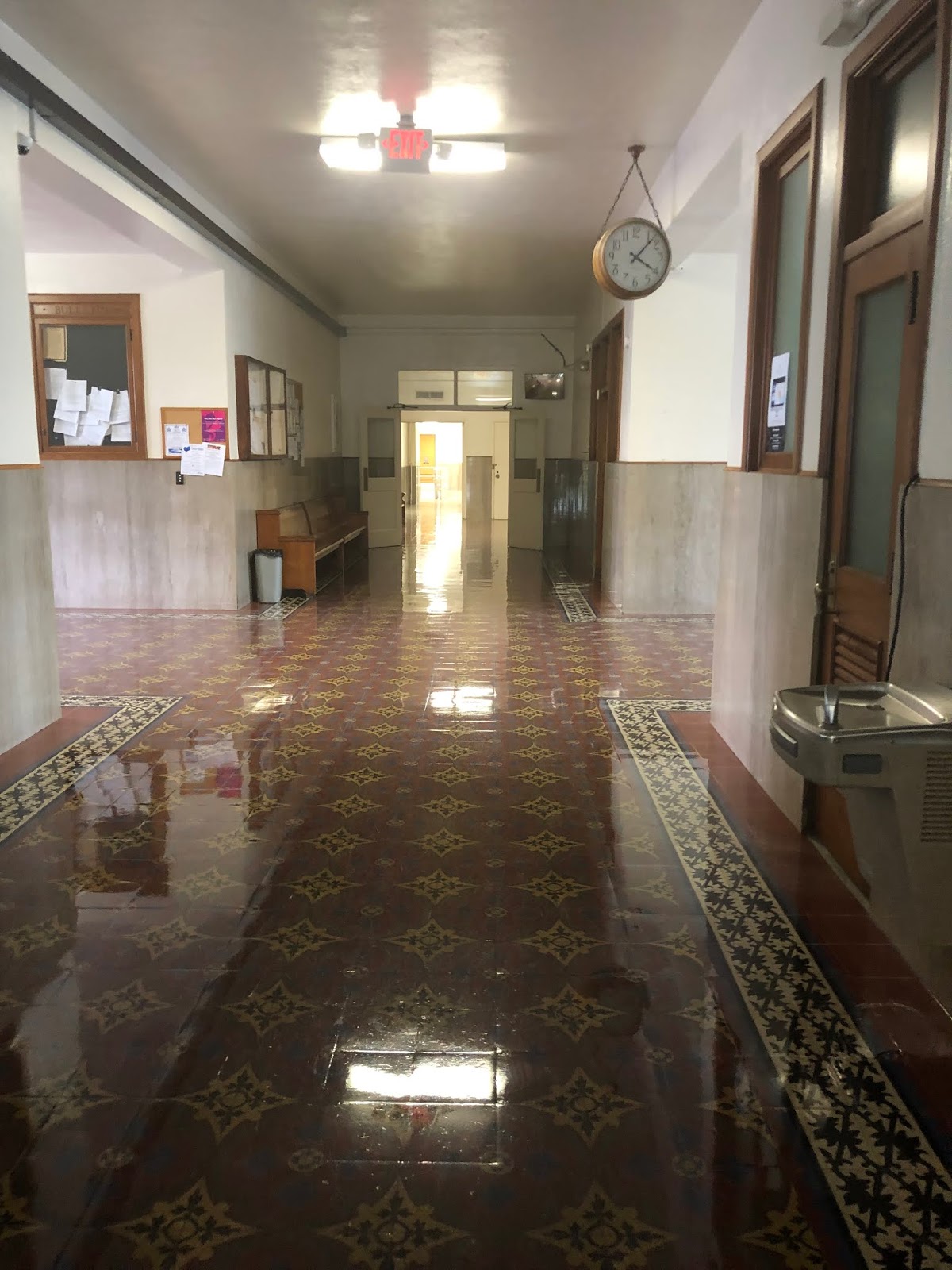
Curtis' design incorporated the era's most current and progressive architectural trends and is now considered one of the earliest examples of Art Deco architecture in Texas. Interestingly it is also referred to as a "modernistic" (or Modern Classical) example of Art Deco in that the interior is relatively unchanged from the courthouse designs of the late 19th century while the exterior reflects the modern influence.
The two story courthouse is constructed of concrete and steel and finished with Texas Cordova Cream limestone. A low earth berm surrounds the windows of the raised basement to give visual height to the flatness of the site. A two story addition, built in 1956, covers most of the west side of the courthouse including the original west entrance, but overall does not detract from the original courthouse design.
| Central first-floor corridor, looking west |
| Original mosaic tile flooring |
| Marble wainscoting and original steam heat radiator in east stairwell |
![]() |
| District Courtroom |
![]() |
| District Courtroom light fixture - bronze with faceted glass |
![]() |
| Northeast corner The waves along the dado represent the nearby Gulf of Mexico. The thin strips of stone set between the larger blocks of limestone give visual appeal. |
![]() |
| North entrance |
Thursday, March 28, 2019
The Ott Hotel
Old buildings may seem boring and useless to some people, but those of us that love them know that while many buildings can be very interesting in their design and history others are just downright fun. Take for instance, the Ott Hotel in Liberty, Texas. Built in 1928 to attract travelers on the nearby Texas & New Orleans railroad and the Old Spanish Trail highway the hotel still serves travelers (and the curious) today. It is also home to several spirits that have garnered much attention over the years!
In the early 1900's the railroad line cutting through Liberty boosted the community into a center for trade, timber and agriculture. The discovery of oil in nearby fields further prompted construction of buildings for restaurants, stores and hotels, including the Ott Hotel built by John and Sallie Ott. The hotel's location adjacent to the railroad tracks and close to the Liberty depot made it popular with rail passengers. Automobile tourists found it a convenient place to spend the night as well as those with business to conduct at the nearby Liberty County Courthouse.
The Ott family owned the hotel until 2002 when it was sold to Kelly and Susan McCain who restored the hotel to its original 1928 appearance. Although, truthfully, from what I saw I can't be certain it is authentic; however, it is fun and delightfully quirky. Today it is still in use as as a hotel and residence and their Facebook page indicated there are weddings held here from time to time. The hotel doesn't have a website and there is very little other information available except for numerous reports of its supernatural activities. In 2005 the Ott Hotel was designated a Texas Historic Landmark.
| First floor hallway |
Many famous people have stayed here including John Wayne, Dale and Roy Evans, and Dan Rather. At least 20 people are said to have died in the hotel with some of their spirits still residing here. The property is a certified "haunted property" having had over 50 paranormal investigations conducted. The day I visited I didn't feel a chill or anything creepy, perhaps the spirits just didn't want to deal with me!
The hotel lobby features an original front desk and other antique memorabilia. Pictures of Liberty through the years line the first floor hallway. From time to time the hotel offers tours and I'm hoping to catch one, but for now it was a fun find!
Wednesday, March 6, 2019
The Alamo 2019
On this day in 1836 a pre-dawn attack by Santa Anna's forces breached the walls of the old mission compound and the defenders inside were all killed. Four days earlier on March 2, 1836, Texas had declared its independence from Mexico while what has come to be known as the Battle of the Alamo had been raging since February 23rd.
A few weeks later the Texan forces under the leadership of Sam Houston would surprise Santa Anna and with the rallying battle cry of "Remember the Alamo" claim victory after an 18 minute battle. The Mexican forces would surrender on May 14th, but would maintain their stance that Texas was not independent and skirmishes would result from time to time. Texas would join the Union in 1845.
To read a chronology of the history of the Alamo click here to visit the Alamo's website.
Just to note I've kept this post short to focus on the commemoration of the fall of the Alamo, but am now planning to do some more posts relating to the Alamo. It has played a vital part in San Antonio's history and while often regarded as a "tourist must visit" site deserves recognition of its entire history. A previous post discussed the history of The DRT Meeting Hall (Alamo Hall) located on the Alamo grounds.
| Approximately 200 men lost their lives when the Alamo was captured; their remains are now interred at nearby San Fernando Cathedral. |
To read a chronology of the history of the Alamo click here to visit the Alamo's website.
Just to note I've kept this post short to focus on the commemoration of the fall of the Alamo, but am now planning to do some more posts relating to the Alamo. It has played a vital part in San Antonio's history and while often regarded as a "tourist must visit" site deserves recognition of its entire history. A previous post discussed the history of The DRT Meeting Hall (Alamo Hall) located on the Alamo grounds.
Thursday, February 7, 2019
The Wedgwood
In December 2014 fire broke out on the third floor and five seniors lost their lives; a sixth would die later of natural causes. The other 250 or so residents were displaced due to major smoke damage; the building was closed after substantional internal demolition took place. The cause of the fire was never determined; however, the building had been completed prior to current fire codes and the only fire sprinklers were in the basement.
![]() |
| Second and third floor windows boarded up after the fire. East side of building. September 2018. |
Described as a “city within a city,” the Wedgwood was a new concept in apartment living. It featured a restaurant, grocery, drugstore, insurance office, clinic, beauty salon and barber shop, dry cleaners, dress shop, and stockbroker’s office. The Wedgwood was a
“complete residential apartment building that puts the dweller above the skyline and provides him with wonderful scenic views, in luxurious comfort and convenience.” San Antonio Light, October 2, 1965, special section.The complex also featured a 49,000 gallon swimming pool, gardens, a lighted waterfall and a putting green. A spacious parking lot surrounded the complex.
![]() |
| Early stages of renovation. Note smoke damage on left of building. September 2018 |
| Renovation in progress with gutting of building. February 2019 |
| East side of building. Note the lettering imprint on the left of building and rock garden entryway visible lower right. February 2019 |
After the tragic fire the State Legislature passed a law that requires Bexar County high-rise buildings with elderly or disabled people comprising a majority of residents to be retrofitted with sprinklers by 2027. In addition to retrofitting the building with the required sprinker system Bernaki is also working with City officials to determine what went wrong at the Wedgwood and additional ways to add safety to the building. Expected re-opening is late 2019.
| A glimpse of the remains of the garden/walking path area visible from a nearby parking lot. |
Saturday, August 11, 2018
Caldwell County Courthouse, Lockhart Texas
The Caldwell County Courthouse clock tower stands high above the surrounding buildings signalling to approaching visitors that they are near the Historic District. The ornate tower is the first hint of the eyecatching details of this 1894 Courthouse designed by Henry E.M. Guidon who eventually became a partner of San Antonio architect Alfred Giles. Contractor was Martin, Brynes and Johnston with an approximate cost of just over $54,000. The plans would be used again for the construction of the Goliad County Courthouse.
The clock tower houses the original 4-sided Seth Thomas clock and 900 pound bell. The clock has been restored after being removed from the tower in 1994 due to poor maintenance and theft of parts. It rested on the dirt floor basement of the County Clerk's building until it was removed in 2008 and restored. It's chime is beautiful!
Designed in the poplar Second Empire style with the Mansard roof and imposing clock tower, the Courthouse has towers that flank the north and south entrances and porticos on the east and west entrances. The porticos were added after the contract was awarded at an additional cost of $600. The walls are sandstone blocks and the trim is "red muldoon stone" as specified in the construction contract.
| Towers flanking the entrance |
The building was built with electricity; water lines would be added later. A remodeling sometime prior to 1978 reconfigured much of the interior and covered original features with drop ceilings and plastic panelling; however, a $1.6 million renovation project between 1991 and 2000 restored the Courthouse interior to much of its original appearance and added HVAC, data/telecommunication capabilities and updated fire alarm and sprinkler systems.
| Second floor courtroom that was converted into offices during the 1970's |
| Second floor courtroom, beautifully restored |
| Second floor courtroom - I believe these benches were from the original courtroom, note the tile floor that is throughout the Courthouse. Balcony is accessible from the third floor. |
The Courthouse was recorded as a Texas Historic Landmark in 1976. The Caldwell County Courthouse Historic District, which includes the Courthouse and 84 surrounding buildings on 25 acres of land, was added to the National Register of Historic Places in 1978.
Monday, July 30, 2018
Gaslight-Baker Theater, Lockhart Texas
My first trip to Lockhart was with the intent of exploring the Caldwell County Courthouse. I had parked on the square and was crossing the street to the Courthouse and glanced to my right for oncoming traffic when I saw this building; I knew immediately that it had been a movie theater at one time and immediately left the square to explore!
Located on a side street off the square, the Gaslight-Baker Theater has been providing citizens with entertainment since its opening night on October 29, 1920. According to the theater's website there were two showings of "Old Kentucky" starring Anita Stewart and an estimated crowd of 1,500-2,000 people attended.
Mr. A.D. (Colonel) Baker had built this theater after his first theater burned; he would continue to own and operate it until his death in 1936. The Baker Show Company owned and operated the facility until 1959 when it was purchased by the Valentine family. The theater remained in operation until March 1984 and sat vacant until 1997 when the Lockhart Community Theater acquired the building and converted it to accomodate live theater productions. Their first production,"Steel Magnolias", opened in October 1998. Ten years later LCT Baker Theater merged with Lockhart's Gaslight Theater to form today's Gaslight-Baker Theater and continues to offer year-round productions. The theater is part of the Caldwell Courthouse Historic District listed on the National Register of Historic Places in 1978.
| Close up of Proscenium Arch visible above stage set |
A plaque on the theater exterior indicates that
The original vaudeville stage, portions of the 1920s interior, 1935 Grande Drape and Proscenium Arch remain intact.
When the two theater groups merged the exterior of the building was refurbished, the lobby updated, and the balcony eventually was re-opened as a seating area. Interestingly, Mrs. Valentine had taken out all the seats and put in shag rugs for theater goers to sit on sometime in the 1970's.
I returned to Lockhart recently to see the current production, The Lion in Winter, which did not disappoint. The staging and acting was outstanding and the theater warm and welcoming.
Subscribe to:
Posts (Atom)