Showing posts with label Ethel Harris. Show all posts

Tuesday, September 15, 2015

Alamo Stadium part 2

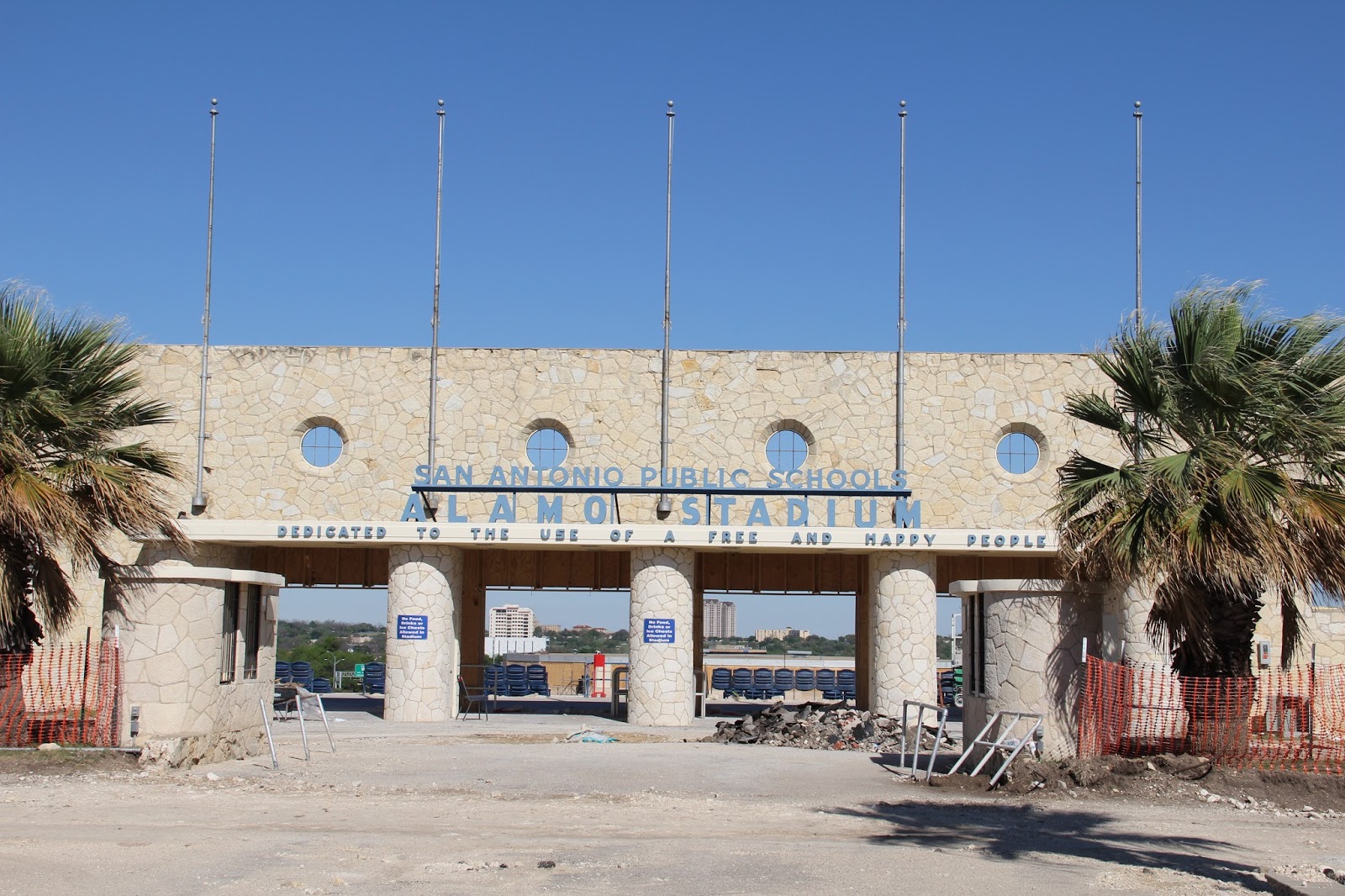
In Alamo Stadium, part one I discussed the many plans and proposals that eventually led to the final approval for a municipal sports facility in San Antonio, Texas.  The funding was provided by the WPA ($370,000) and from revenue bonds issued by San Antonio ISD ($107,000).  The stadium was designed by Phelps, Dewees, and Simmons.  Henry T Phelps designed many prominent buildings and homes in this area (Atascosa County Courthouse and other projects ) were featured previously on this blog. 

During renovation


After

The nomination form for the National Register of Historic Places states that the stadium's design is consistent with the Art Deco period. The linear entrance canopy of the west (main) entrance and curved pillars are examples of the Art Deco influence.  This entrance is situated at the highest point of the old rock quarry and gives a breath taking view of San Antonio's skyline to the south.  A wide concrete promenade leads up to the entrance from Stadium Drive.


The east entrance, often referred to as the visitor side, is not as impressive as the west entrance. I didn't photograph this, but as you approach the east entrance there is a set of rather steep concrete steps to the left.  If you venture up the steps you arrive at the south entrance where there is also a nice view of downtown as well as an overlook into Highway 281! This entrance has a lower height as it follows the topography of the old quarry along its perimeter.

The crown jewel to me are the four tile murals above the main entrance that depict scenes of sporting events in San Antonio. Henry Wedemeyer, assisted by Leonora Feiler, designed the murals.  Ethel Harris served as the supervisor of the local WPA Arts & Crafts Division and coordinated 60 WPA workers from her Mexican Arts & Crafts studio to create these stunning panels.  Each mural contains 192 tiles and measures five feet high by 13 feet wide; each tile is 6 inches square and 3/4 inch thick. The murals were removed during the renovation and restored before being re-installed.


Ethel Harris' signature maguey craftsman's mark (modified for the WPA) appears in the lower right corner tile of this picture

 
The City of San Antonio also applied for WPA funding to improve the streets in the surrounding neighborhood of the stadium. Streets were widened and repaved and simultaneously were developed into a new system of more convenient routes to the new Stadium. This was done in anticipation of the vehicles that would be coming on game days to the facility and appeasing the surrounding neighborhoods.

You have to look close to see this marker - it is embedded in the curb in front of this building on North St. Mary's Street.


The marker is partially obscured by subsequent layers of asphalt. It gives a date of 1938-1940.

The opening night game was a double header:  Jefferson vs Corpus Christi followed by Reagan-Houston.  You certainly would not see this today, but the San Antonio Brewing Association (Pearl Beer) was one of local businesses who sponsored advertisements in the paper supporting the new stadium prior to its opening!  And, not surprisingly, traffic that night was a mess taking over an hour for it to clear.  Have you ever been to a football game and didn't have to wait in a lengthy queue of traffic to get out of the stadium?

Tuesday, August 4, 2015

Dallas Heritage Village

My last post featured the Dallas Heritage Village and its history.   Each building on the grounds was moved there from a location either in Dallas or North Texas. The visitors guide and information plaques by each one gave me a feel for that building's (or a similar building's) contribution to the history of the area.  Since there are 21 buildings featured on the property I can only feature a few here.  But do visit their web site to read about all of them and the service that the Village provides to the Dallas community.  Just to note, the Village is closed during August so they can do upkeep and other projects.

I had posted about the Renner School on Small Simple Things of Life, so click here to read about it.
I wrote about the Millermore house on the first post.  So, that covers two of the buildings.

As soon as I walked into the Village the depot caught my eye; I'm always drawn to depots and trains.
The first train rolled into Dallas in July 1872 and a year later the Texas & Pacific arrived in town.  Dallas became the first major railroad crossing in the southwest, linked to Kansas City, St. Louis and Chicago.  The population of Dallas soared and business boomed!

This depot was built in 1886 and served the Missouri, Kansas, and Texas (MKT or KATY) line. Each railroad used standardized colors and most buildings followed a similar plan with a gabled roof and hipped ends. The depot is painted in the MKT's colors.  Prior to its relocation it had been cut in half and one half was being used for hay storage. All aboard!


The Worth Hotel was built in Carrollton in 1904.  Hotels were vital to the railroads.  Often space was limited and guests not only had to share rooms they often had to share beds!
The Sullivan house was built a few blocks away from the Village in 1885.  Mr. Sullivan was a plumbing and gas fitting contractor and the house featured an indoor bath and gas fixtures. I found it interesting that the picture of the house in its original location showed it to be painted white. Isn't this color scheme much more pleasing?

 
The Gano house was built in the dog-trot style in 1846 near Grapevine.  This practical plan of joining two rooms with a breezeway offered cross-ventilation.  The dog-trot house was very common in Texas.  In 1852 two rooms were added to the back as well as the loft above making it very roomy.  The house was covered with hand planed siding for extra insulation.
Like most parks of this time City Park had a gazebo (bandstand) similar to this one. 
The Main Street features buildings that would have been typical of Dallas in the late 1800's.  A saloon, a bank, a general store, and a law office comprise this street.  The murky day and small camera kept me from capturing the Dallas skyline just behind the trees, but it was a vivid contrast.
The Blum House, built in 1901, is currently closed.  This poor lady needs another makeover and the Village is currently soliciting funds.  The DHV is a non-profit 503(c) organization and gladly accepts donations and other forms of support.  At this time they do not plan to add any other structures unless they come with their own endowment.  Upkeep is costly!


Saturday, September 6, 2014

Ethel Harris' Mexican Arts & Crafts pottery


Ethel Wilson Harris was already the owner of a well-established decorative tile business, Mexican Arts and Crafts, in San Antonio when she became the local technical supervisor of the Arts and Crafts division of the WPA in San Antonio in 1939.  Her staff of approximately 60 local artisans manufactured decorative clay tiles; during the time of the shop’s involvement with the WPA the tiles would not be sold but offered to charitable and public organizations. 

The tiles from her WPA involvement are seen today in two plaques along the San Antonio River and in other locations. In 1937 she had copyrighted a book of designs and the full blooming maguey plant as her craftsman’s mark.  During the two years of her WPA work she modified the maguey to indicate that the work was for the WPA.
The modified maguey is in the bottom center tile and forms the letters WPA at the top and AC at the bottom for the Arts and Crafts division
This version of the maguey (seen above the letter "O") also shows the year of completion
Mrs. Harris was very involved in local preservation efforts.  After Mission San Jose was restored she requested permission to open a shop in the granary to make and sell decorative tiles and other native made crafts; this business would be known as Mission Crafts.  She was also affiliated with San Jose Potteries in the mid-1930's.

As a young widow she would move into an apartment in the western wall of the mission; this was permitted in an effort to prevent vandalism to the mission but also allowed her to live close to her shop.

In 1941 after San Jose was designated a National Historic Site she was chosen to be the park’s manager, making her the first woman to be appointed as the site manager for a Texas State Park. She would remain in this position until her retirement in 1963.   

In 1956 she built a house on adjoining property, living there until the early 1980’s.  The house, listed on the National Register of Historic Places in 2001, was designed by her son, Robert, to fit on a foundation she had already laid.  It is 2,000 square feet in size and built using frame, stone and concrete construction. The design is thought to resemble the "Usonian" style of Frank Lloyd Wright.

Mrs. Harris closed her business in 1977 and passed away in 1984. Her tiles today are considered collector’s items.

Sources referenced and for further reading:
http://doorwayintothepast.blogspot.com/2013/03/mission-san-jose-y-san-miguel-de-aguayo_22.html

http://doorwayintothepast.blogspot.com/2013/06/mission-san-jose-revisited.html

Fisher, L. F. (2007). Riverwalk: The Epic Story of San Antonio's River. San Antonio: Maverick Publishing Company.